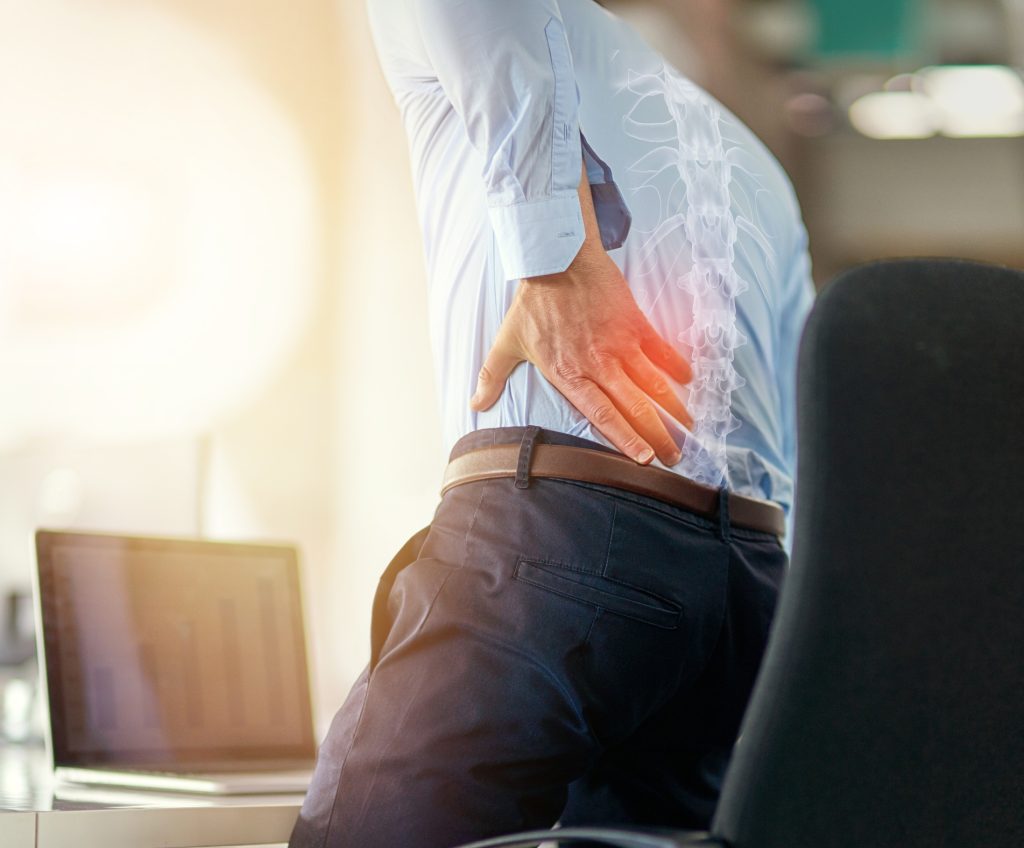
If you’re living with chronic back pain caused by a slipped, bulging or herniated disc, or degenerative disc disease, you may want to know what comes next. Maybe you’ve already tried rest, physical therapy, medications, or spinal decompression. You may have had some improvement, but the pain comes back, and you’re worried that surgery is your only option at this point.
If you’ve been struggling with disc-related back pain that hasn’t improved with conservative care, don’t assume surgery is your only option. Many people find relief with minimally invasive treatments before considering spine surgery.
Modern interventional pain management offers several minimally invasive procedures designed to target the source of your pain, reduce inflammation, and improve your quality of life. While these treatments aren’t right for everyone, they may help you find long-term relief and, in some cases, delay or even avoid traditional spine surgery.[1]
Why Does a Herniated or Bulging Disc Cause Back Pain?
The discs between the bones of your spine act like cushions, helping absorb shock every time you walk, bend, twist, or lift something.[2]
As you age or after an injury, those discs can begin to wear down, develop small tears, or bulge beyond their normal space.[3] If a damaged disc irritates or compresses a nearby spinal nerve, you may experience back or neck pain along with numbness, tingling, weakness, or pain that travels into your arm or leg.[4]
Not every abnormal disc causes pain, which is why identifying the true source of your pain is one of the most important parts of creating an effective treatment plan.[5]
Minimally Invasive Procedures That May Help Relieve Disc Pain
The best treatment for disc-related pain depends on what’s causing your pain. After reviewing your symptoms, physical exam, and imaging studies, your pain specialist may recommend one or more of these targeted, minimally invasive procedures:
Epidural Steroid Injections (ESIs)
If a herniated or bulging disc is irritating a spinal nerve, inflammation is often responsible for much of your discomfort.[3] An epidural steroid injection (ESI) delivers anti-inflammatory medication around the affected nerve to help calm that inflammation.[6] An ESI won’t repair your damaged disc, but reducing inflammation may relieve pain enough for physical therapy to be effective and get you back to your normal daily activities.[1; 6]
Intracept® Procedure (Basivertebral Nerve Ablation)
Not all chronic low back pain comes from a herniated disc pressing on a nerve. Sometimes, the pain comes from changes in the vertebral endplates, the bone above and below a damaged disc. This type of pain, called vertebrogenic pain, is associated with irritation of the basivertebral nerve.[7]
The Intracept® Procedure is designed to treat vertebrogenic low back pain by interrupting pain signals carried by the basivertebral nerve. Clinical studies have shown significant improvements in pain and function, with many patients experiencing lasting relief.[7]
Percutaneous Cervical Disc Nucleoplasty
If you have a contained herniated disc in your neck that is causing arm pain or other symptoms, you may be a candidate for percutaneous cervical disc nucleoplasty. This minimally invasive procedure uses a specialized device to remove a small amount of disc material, reducing pressure inside the disc and relieving pressure on nearby nerves.[5]
Because it’s performed through a needle instead of a large incision, recovery is often quicker than traditional open spine surgery. While it isn’t right for every type of disc problem, it may provide noticeable relief for some patients with contained cervical disc herniations.[5]
Percutaneous Plasma Disc Decompression (Nucleoplasty)
Percutaneous plasma disc decompression, sometimes called nucleoplasty, is another minimally invasive option for certain patients with contained disc herniations. Using low-temperature plasma radiofrequency technology, your provider removes a very small amount of disc tissue to reduce pressure within the disc.[5]
By reducing pressure inside the disc, this procedure may relieve pressure on irritated spinal nerves and help reduce pain radiating into the arms or legs. Because only a small amount of disc material is removed, the procedure preserves much of the disc’s natural structure while avoiding the larger incisions required for traditional surgery.[5]
VIA Disc® NP Allograft
For some patients with chronic discogenic pain caused by degenerative disc disease, newer regenerative therapies may be an option.[8]
VIA Disc® NP is an injectable allograft designed to supplement the nucleus pulposus, the soft center of the spinal disc that naturally loses hydration and structure over time. Early research has shown promising improvements in pain and function, although ongoing research is evaluating its long-term effectiveness.[8]
Spinal Cord Stimulation (SCS)
If you’ve been living with chronic nerve-related pain that hasn’t responded to more conservative treatments, spinal cord stimulation may be worth discussing with your doctor.[3]This therapy uses a small implanted device to modify pain signals before they reach your brain.
While it doesn’t heal the damaged disc itself, it may help reduce pain and improve your quality of life.
When To Consider Interventional Pain Management for Disc Pain?
If you’ve tried rest, medications, physical therapy, or other conservative treatments without getting the relief you hoped for, it may be time to talk with a pain management specialist. Targeted procedures are often considered when pain continues to interfere with your daily life, sleep, work, or the activities you enjoy despite appropriate conservative care.
The goal isn’t to rush into a procedure. It’s to find the least invasive treatment that gives you the best chance of reducing pain and improving function. In many cases, that means taking a multidisciplinary approach that combines minimally invasive procedures with physical therapy, activity modification, exercise, and other conservative treatments to help you achieve the best possible outcome.[1; 6]
Treating Disc Pain Starts with the Right Diagnosis
One of the biggest challenges with disc-related pain is determining whether a damaged disc is actually causing your symptoms. MRI findings alone don’t always tell the whole story. In fact, many people have bulging or degenerative discs on imaging but experience little or no pain.[3] That’s why your pain specialist won’t rely on MRI findings alone when recommending treatment. Your symptoms, medical history, physical examination, and imaging studies all help paint the full picture.[https://www.hss.edu/health-library/conditions-and-treatments/list/herniated-disc]
Diagnostic Methods
If the source of your pain is still unclear, additional diagnostic procedures may help. A discogram (discography) can identify whether a specific disc is causing your pain, while a selective nerve root injection (SNRI) can help determine which irritated spinal nerve is responsible for your symptoms. These procedures aren’t treatments for disc pain, but they can provide valuable information that helps your provider recommend the most appropriate treatment for your condition.[5]
Disclaimer: This content is for educational purposes only and is not a substitute for medical advice, diagnosis, or treatment. Pain conditions and treatment options vary from person to person, so always talk with a qualified healthcare provider about what’s right for you. If you experience sudden or worsening pain, or symptoms like numbness, weakness, chest pain, shortness of breath, or changes in bladder or bowel control, seek medical care right away.
Resources:
- Herniated disk – Diagnosis & treatment. Mayo Clinic [Internet]. Accessed July 03, 2026. Available from: https://www.mayoclinic.org/diseases-conditions/herniated-disk/diagnosis-treatment/drc-20354101
- Degenerative Disk Disease. Cleveland Clinic [Internet]. Accessed July 03, 2026. Available from: https://my.clevelandclinic.org/health/diseases/16912-degenerative-disk-disease
- Al Qaraghli MI, De Jesus O. Lumbar Disc Herniation. [Updated 2023 Aug 23]. In: StatPearls [Internet]. Treasure Island (FL): StatPearls Publishing; 2026 Jan-. Accessed July 03, 2026. Available from: https://www.ncbi.nlm.nih.gov/books/NBK560878/
- Herniated disk – Diseases & Conditions. Mayo Clinic [Internet]. Accessed July 03, 2026. Available from: https://www.mayoclinic.org/diseases-conditions/herniated-disk/symptoms-causes/syc-20354095
- Ravikanth R. A review of discogenic pain management by interventional techniques. J Craniovertebr Junction Spine. 2020 Jan-Mar;11(1):4-8. doi: 10.4103/jcvjs.JCVJS_19_20. Epub 2020 Apr 4. PMID: 32549705; PMCID: PMC7274356. Accessed July 03, 2026. Available from: https://pmc.ncbi.nlm.nih.gov/articles/PMC7274356/
- Pain relief for worn spinal disks. Mayo Clinic Health System [Internet]. Published June 26, 2024. Accessed July 03, 2026. Available from: https://www.mayoclinichealthsystem.org/hometown-health/speaking-of-health/pain-relief-for-worn-spinal-disks
- Ding S, Chen J, Wu Y, Lin H, Liang Q, Teng G, Liu Z, Huang M. Application of a novel extracorporeal membrane oxygenation system in awake Hu sheep under various durations. BMC Anesthesiol. 2025 Feb 6;25(1):59. doi: 10.1186/s12871-025-02930-5. PMID: 39915714; PMCID: PMC11800640. Accessed July 03, 2026. Available from: https://pmc.ncbi.nlm.nih.gov/articles/PMC11800640/
- El Melhat AM, Youssef ASA, Zebdawi MR, Hafez MA, Khalil LH, Harrison DE. Non-Surgical Approaches to the Management of Lumbar Disc Herniation Associated with Radiculopathy: A Narrative Review. J Clin Med. 2024 Feb 8;13(4):974. doi: 10.3390/jcm13040974. PMID: 38398287; PMCID: PMC10888666. Accessed July 03, 2026. Available from: https://pmc.ncbi.nlm.nih.gov/articles/PMC10888666/