
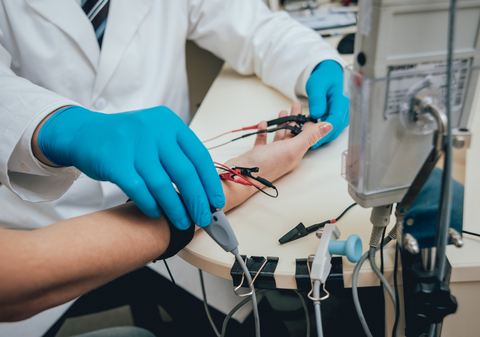
Dealing with constant nerve pain can feel overwhelming, especially if you don’t know exactly what’s causing it. Advanced tests, such as electromyography (EMG) and nerve conduction studies (NCS), enable your doctor to conduct a detailed examination of how your muscles and nerves are functioning. Once your pain management specialist understands the underlying cause of your discomfort and other symptoms, they can create a personalized treatment plan tailored to your specific needs.
What Are EMG and Nerve Conduction Studies?
Electrodiagnostic tests are specialized studies that assess the function of your nerves and muscles. They examine your peripheral nerves, spinal nerve roots, nerve networks (plexuses), neuromuscular junctions (where muscles and nerves meet), and the muscles themselves.[1]
Even though EMG and nerve conduction studies both record electrical activity and are usually ordered together, they’re not the same test.
These tests are classified into two primary types:
Electromyography (EMG)
EMGs measure the electrical activity in your muscles and nerve cells (motor neurons).[2] There are two types of EMG: surface (noninvasive) and intramuscular needle (invasive). [1] Surface EMGs utilize electrodes placed on the skin near the affected area.
During the intramuscular test, a very thin needle electrode is placed into a muscle to record how it responds when you contract and relax it. This helps determine whether your muscle weakness or pain is caused by a problem within the muscle itself or in the nerves that control it.[2]
Nerve Conduction Studies (NCS)
NCS, or nerve conduction velocity (NCV), measures how fast and strong electrical signals travel through your motor or sensory nerves.[3] Small patches (electrodes) are placed on the skin, and mild electrical impulses are sent through the nerve to stimulate it and record its response. Combined with an EMG, it can help identify whether a nerve is damaged, compressed, or not functioning normally, and if the muscles are affected.[1]
Why Your Doctor Ordered Electrodiagnostic Testing
Many people with chronic pain struggle for months or even years before finding a trustworthy source for their symptoms. EMG and NCS provide doctors with objective data, rather than relying solely on symptoms or imaging tests.
These studies can:
- Pinpoint whether your pain is coming from nerve injury, nerve compression, or muscle dysfunction [4]
- Distinguish between conditions that feel similar, like peripheral neuropathy versus a pinched nerve in your spine [2]
- Help your pain specialist decide if treatments like physical therapy, medications, or interventional procedures (such as nerve blocks) might help [5]
Common Conditions Diagnosed
Since nerve pain can originate from various sources, these diagnostics are typically the final step in confirming the cause. These tests can help find the “why” behind mysterious symptoms like numbness, tingling and ongoing pain.
Some of the most common nerve-related conditions that EMG and NCS help identify include:
- Peripheral neuropathy [1]
- Radiculopathy (pinched nerve) [1]
- Plexopathies [1]
- Neuromuscular junction disorders [1]
- Nerve entrapment and other mononeuropathies [1]
- Myopathies and myositis [1]
- Carpal tunnel syndrome [4]
- Sciatica [4]
- Nerve compression syndromes [4]
- Nerve injury [5]
- Muscular dystrophy (MD) [5]
- Guillain-Barré syndrome [5]
- Myasthenia gravis [5]
- Herniated discs [5]
- Charcot-Marie-Tooth disease (CMT) [5]
- Amyotrophic lateral sclerosis (ALS) [5]
How Do EMG and Nerve Conduction Tests Help With Pain Management?
Once you know the exact cause of your nerve pain, your treatment plan becomes much clearer. For example:
Pinched nerves in your neck or back can be treated with epidural injections, nerve blocks, or other minimally invasive procedures.
Neuropathy pain can be improved by managing the underlying cause (like blood sugar control in diabetes), medication, lifestyle changes and advanced therapies [6]
Carpal tunnel responds to splinting, injections, or surgery if nothing else helps [3]
Bringing It All Together: EMG and NCS Results Guide Your Pain Management Treatment
Getting EMG and nerve conduction study results is often the turning point in your pain journey. Instead of guessing or treating only the symptoms, your doctor uses EMG and NCS to take the guesswork out of why you have nerve-related pain. With that vital information, your pain management team can build a comprehensive treatment plan that may include physical therapy, medications, interventional procedures, lifestyle adjustments, and even complementary therapies.
The goal isn’t just temporary relief, but long-term improvement in your comfort, mobility, and quality of life. Now that you understand how these tests work, remember: they’re not just about identifying what’s wrong—they’re about giving you and your doctor the tools to move forward. Once you know the actual cause of your nerve pain, you can finally start on the path toward real relief and reclaiming your life.
Resources:
- Ramani PK, Lui F, Arya K. Nerve Conduction Studies and Electromyography. [Updated 2025 Feb 10]. In: StatPearls [Internet]. Treasure Island (FL): StatPearls Publishing; 2025 Jan-. Accessed September 21, 2025. Available from: https://www.ncbi.nlm.nih.gov/books/NBK611987/
- Mayo Clinic Editorial Staff. Electromyography (EMG). Mayo Clinic [Internet]. Published May 21, 2019. Accessed September 21, 2025. Available from: https://www.mayoclinic.org/tests-procedures/emg/about/pac-20393913
- Nerve Conduction Studies. Johns Hopkins Medicine [Internet]. Accessed September 21, 2025. Available from: https://www.hopkinsmedicine.org/health/treatment-tests-and-therapies/nerve-conduction-studies
- Nerve Conduction Study. Cleveland Clinic [Internet]. Accessed September 21, 2025. Available from: https://my.clevelandclinic.org/health/treatments/24821-nerve-conduction-study
- Electromyography (EMG) and Nerve Conduction Studies. MedlinePlus [Internet]. Published 2023. Accessed September 21, 2025. Available from: https://medlineplus.gov/lab-tests/electromyography-emg-and-nerve-conduction-studies
- Mayo Clinic Editorial Staff. Peripheral neuropathy – Diagnosis and treatment. Mayo Clinic [Internet]. Published 2025. Accessed September 21, 2025. Available from: https://www.mayoclinic.org/diseases-conditions/peripheral-neuropathy/diagnosis-treatment/drc-20352067