
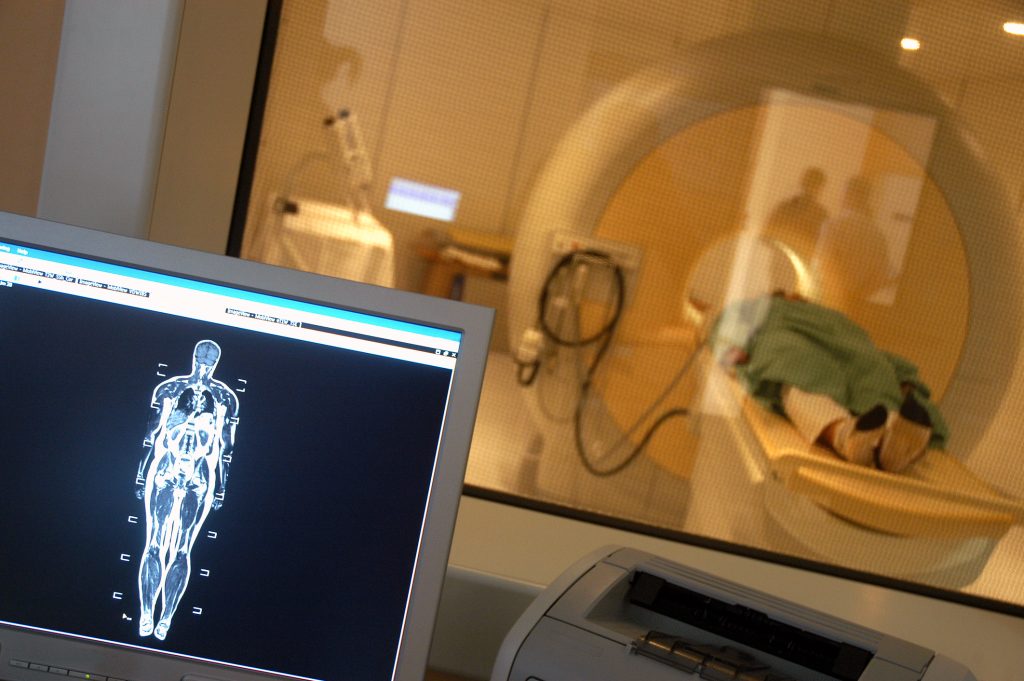
If you’ve ever been told you might need an injection for pain relief for your back, neck, or a joint, you may have wondered why your doctor wants an MRI first. It’s not just about confirming what hurts; it’s about seeing exactly what’s going on beneath the surface so your treatment can be as precise and effective as possible.
An MRI, or magnetic resonance imaging scan, provides doctors with a detailed, three-dimensional view of your soft tissues, joints, spine, nerves, and areas of inflammation without radiation. [1] It’s much more detailed than an X-ray or fluoroscopy (or ultrasound) and is ideal for diagnosing the source of pain, while those other tools are better for real-time guidance during the injection itself. This level of detail helps your pain management specialist decide whether an injection is the right next step and, if so, plan exactly where it needs to go.
From MRI Scan to Solution: What Happens Before Your Injection
Before performing a therapeutic injection, your doctor uses MRI images to identify the exact source of pain. MRIs can show inflammation, nerve compression, herniated discs, joint damage, or scar tissue that may not appear on X-rays or CT scans.[2]
Once the problem area is identified, your doctor can tailor the injection to target the affected structure, such as a nerve root, joint capsule, or soft-tissue pocket.
Common pain management injections planned with MRI include:
Spine-related injections:
- Epidural steroid injections for disc herniation or sciatica [3; 4]
- Facet joint injections for arthritis-related back or neck pain [5]
- Sacroiliac (SI) joint injections for lower back or pelvic pain [6]
- Selective nerve blocks to target nerve compression [7]
- Sympathetic nerve blocks for complex regional pain syndrome (CRPS) or pelvic pain [2]
- Coccygeal or ganglion impar blocks for tailbone or pelvic pain [7]
- Piriformis muscle injections to confirm piriformis syndrome or exclude spinal causes [5]
Joint and soft-tissue injections:
- Intra-articular joint injections (shoulder, hip, knee) when MRI shows cartilage or ligament injury [8]
- Bursa injections (trochanteric or subacromial) to confirm inflammation or fluid buildup [6]
- Trigger point injections to locate deep muscular or myofascial pain sources [8]
Regenerative or biologic treatments:
- Stem cell, PRP, prolotherapy, or allograft injections, where MRI helps identify damaged tissue and track healing [2; 8]
Sometimes, a contrast dye (gadolinium) is used during MRI to make inflammation or scarring more visible.[1] However, the injection procedure itself doesn’t typically use contrast dye unless your doctor needs it to confirm that the medication reached the correct location.
In most cases, MRI is used before the injection to map out the best approach, while fluoroscopy (X-ray guidance) or ultrasound may be used during the injection for real-time visualization [4]
Why Precision Injections Matter in Pain Management
When it comes to pain relief, where the medication goes is just as important as what’s in it. MRI helps your pain management specialist find the *exact* source of pain—whether it’s a pinched nerve, inflamed joint, or damaged soft tissue—so treatment is more effective and longer-lasting [1]
Better targeting, better results:
By showing the anatomy in great detail, MRI ensures that injections are placed precisely where inflammation, nerve irritation, or tissue damage is occurring. This helps maximize relief while minimizing unnecessary exposure to medications or repeated procedures.[4]
Personalized care for complex pain:
Many patients have more than one source of discomfort—such as overlapping spinal and joint pain. MRI allows your provider to visualize these layers clearly and plan a treatment sequence tailored to your specific anatomy.[6]
Guided progress and safety:
MRI can also be used to track healing after regenerative injections, such as PRP or stem cell therapy, confirming tissue repair or reduced inflammation over time.[8] For patients with implants, prior surgeries, or scar tissue, MRI helps avoid areas that might complicate needle placement [3; 7]
Pain management is not one-size-fits-all, but an MRI scan gives your care team the insight they need to make your treatment plan as safe and effective as possible.
MRI Imaging: Taking the Guesswork Out of Pain Relief
If you’ve been living with chronic pain, it’s easy to feel frustrated or discouraged when nothing seems to help. But advanced imaging like MRI is changing that. By combining detailed imaging with targeted injection therapy, doctors can now deliver relief with greater accuracy and confidence than ever before.
Every image tells a story, and in pain management, that story helps your doctor choose the safest path toward lasting comfort. If your provider recommends an MRI before an injection, it’s not an extra step; it’s the foundation for precision treatment and better results.
Ready to take the next step toward real relief? Ask your pain management specialist how MRI-guided planning can help you find solid answers and comfort through more precise injections.
Disclaimer: This blog is for educational purposes only and should not replace professional medical advice, diagnosis, or treatment. If you experience sudden, severe, or worsening pain — especially if it’s accompanied by symptoms like fever, numbness, weakness, shortness of breath, chest pain, or loss of bladder or bowel control, seek immediate medical care. Don’t wait for your next pain management appointment.
Resources:
- MRI (Magnetic Resonance Imaging). Cleveland Clinic [Internet]. Accessed November 12, 2025. Available from: https://my.clevelandclinic.org/health/diagnostics/4876-magnetic-resonance-imaging-mri
Hakim BR, Munakomi S. Interlaminar Epidural Injection. [Updated 2023 Aug 13]. In: StatPearls [Internet]. Treasure Island (FL): StatPearls Publishing; 2025 Jan-. Accessed November 12, 2025. Available from: https://www.ncbi.nlm.nih.gov/books/NBK545197/
Lee JH, Lee JH, Chang MC. Transforaminal Epidural Steroid Injection for Patients with Lumbosacral Disc Herniation in the Absence of Spine Magnetic Resonance Imaging – Is Better Really the Enemy of the Best?. J Pain Res [Internet]. 2023;16:1477-1485 https://doi.org/10.2147/JPR.S402405 Accessed November 12, 2025. Available from: https://www.dovepress.com/transforaminal-epidural-steroid-injection-for-patients-with-lumbosacra-peer-reviewed-fulltext-article-JPR
Fritz, Jan MD*; Sequeiros, Roberto Blanco MD†; Carrino, John A. MD*. Magnetic Resonance Imaging–Guided Spine Injections. Topics in Magnetic Resonance Imaging [Internet]. 22(4): :p 143-151, August 2011. | DOI: 10.1097/RMR.0b013e31827e5de1 Accessed November 12, 2025. Available from: https://journals.lww.com/topicsinmri/fulltext/2011/08000/magnetic_resonance_imaging_guided_spine_injections.3.aspx
Kim MS, Jeong TY, Cheong YS, et al. Effect of epidural corticosteroid injection on magnetic resonance imaging findings. Korean J Pain [Internet]. 2017;30(4):281-286. doi:10.3344/kjp.2017.30.4.281 Accessed November 12, 2025. Available from: https://pmc.ncbi.nlm.nih.gov/articles/PMC5665740/
Uka M, Matsui Y, Iguchi T, et al. Magnetic Resonance Imaging Guidance for Percutaneous Needle Intervention. Interv Radiol (Higashimatsuyama) [Internet]. 2023;9(3):92-98. Published 2023 Dec 14. doi:10.22575/interventionalradiology.2023-0033 Accessed November 12, 2025. Available from: https://pmc.ncbi.nlm.nih.gov/articles/PMC11570213/
Fritz J, Thomas C, Nikolay Tzaribachev, et al. MRI-Guided Injection Procedures of the Temporomandibular Joints in Children and Adults: Technique, Accuracy, and Safety. American Journal of Roentgenology [Internet]. 2009;193(4):1148-1154. doi:https://doi.org/10.2214/ajr.09.2473 Accessed November 12, 2025. Available from: https://ajronline.org/doi/10.2214/AJR.09.2473?doi=10.2214/AJR.09.2473
Hasoon J, Malik A, Robinson CL, Chen GH, Gill J. Preprocedural Imaging Review Before Performing Epidural Steroid Injections: Analysis of Physician Practice Parameters. Diagnostics (Basel) [Internet]. 2025;15(6):729. Published 2025 Mar 14. doi:10.3390/diagnostics15060729 Accessed November 12, 2025. Available from: https://pmc.ncbi.nlm.nih.gov/articles/PMC11941027/