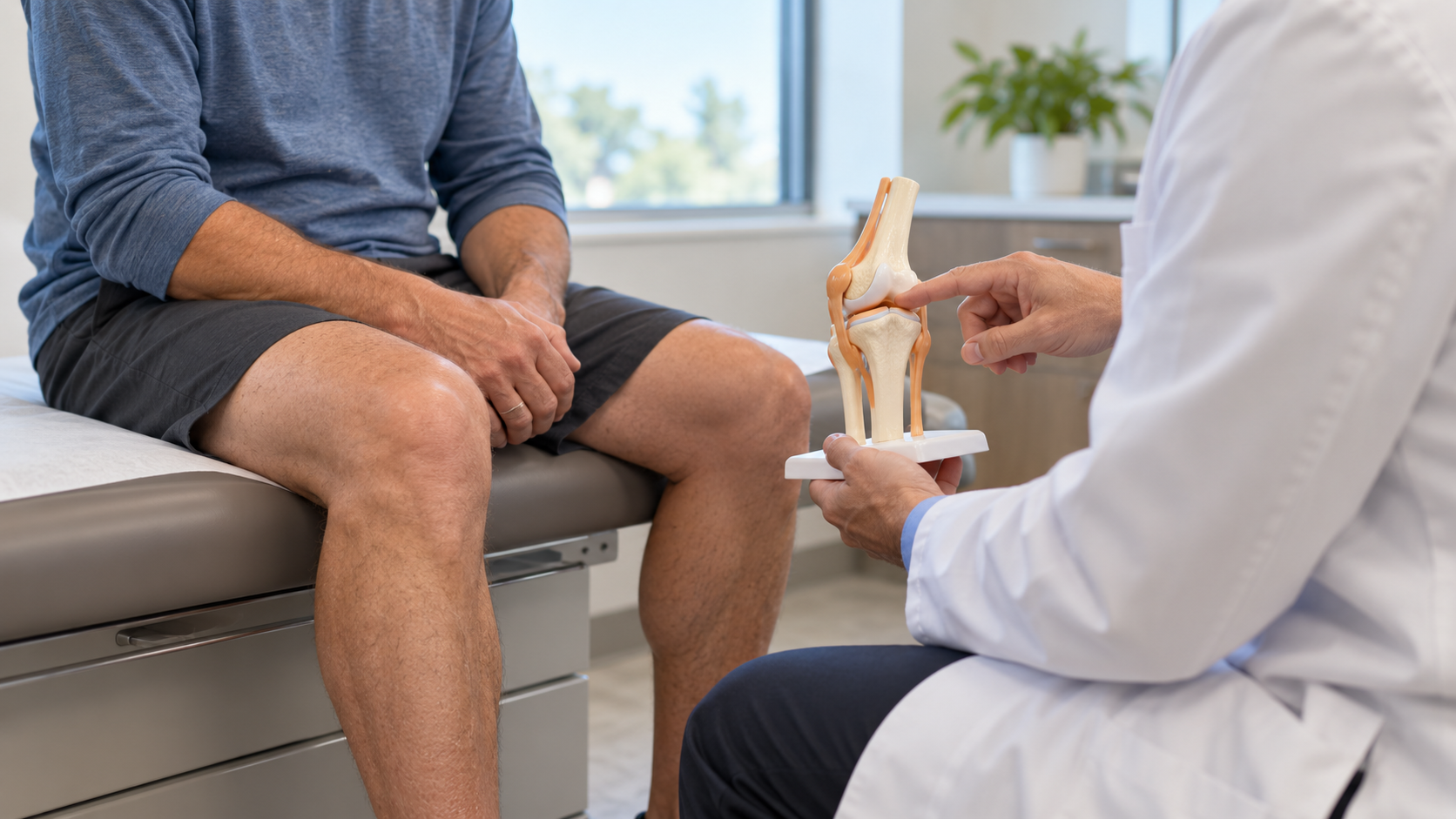

Pain might be the symptom that brings you to a doctor, but pain itself isn’t the final diagnosis. In medicine, the real goal is figuring out why the pain is happening. Without identifying the actual source of your aches and pains, treatment often becomes little more than chasing symptoms instead of solving the problem.
Avoiding a “treat-the-symptom-only” approach is why pain specialists take a deeper, more investigative look at pain. Interventional pain management focuses on identifying the root cause of pain using a combination of patient history, physical examination, diagnostic tests, and targeted procedures. Finding the real source isn’t always simple, but when doctors understand where pain is coming from, they can design more effective and lasting treatment plans.
Your Pain Story Is Your Doctor’s First Diagnostic Tool
Before any tests are ordered, pain specialists start with something surprisingly powerful: your story.
Pain doctors spend time asking detailed questions about when your pain started, where it travels, what it feels like, and what makes it better or worse. This information helps doctors narrow down possible causes because different conditions produce different pain patterns. For example, nerve pain often feels burning or electric, while inflammatory pain may feel stiff or throbbing.[1]
Your doctor may ask about:
- When the pain began
- What triggers or relieves it
- Whether the pain spreads or travels
- Previous injuries, illnesses, or surgeries
- If you repeatedly miss work, school or life events
Because this information is so vital, many specialists recommend keeping a simple pain journal before your visit. Tracking symptoms, timing, and triggers can give your doctor valuable clues that guide the diagnostic process.
Pain is also highly individual and difficult to measure objectively, which is one reason diagnosing its source can be challenging.[2]
Diagnostic Tools Pain Specialists Use to Find the Source
Once your doctor has listened to your symptoms and completed an initial evaluation, the next step is to confirm what may be causing your pain. Pain specialists rely on a combination of physical examination, medical imaging, nerve testing, and targeted diagnostic procedures to narrow down the exact source.
Each tool provides a different piece of the puzzle. When these pieces are put together, they help doctors move from a general symptom of pain to a much more precise diagnosis.
The Physical Exam: Looking for Clues to the Root Cause of Your Pain
A careful physical examination is the next step in identifying the cause of pain. During the exam, your doctor looks for clues in how your body moves and responds to certain tests.
The physical exam usually consists of:
- Range of motion
- Muscle strength
- Reflexes
- Areas of tenderness
- Changes in sensation or numbness
These findings can help pinpoint whether pain is likely to come from muscles, joints, nerves, organs, or the spine, since different tissues tend to produce different types of pain signals. A physical exam can also reveal patterns of nerve irritation or spinal compression that may require further testing.[3]
Imaging: Searching for Causes of Pain Inside Your Body
Sometimes the source of pain lies beneath the surface. To see what’s happening inside your body, doctors may use imaging.
Common radiology tools include:
- X-rays: show bone alignment and fractures [4]
- CT scans: provide detailed cross-sectional images of bones and tissues [5]
- MRI scans: reveal soft tissues like discs, ligaments, and nerves [6]
Medical imaging can help identify conditions such as herniated discs, arthritis, spinal stenosis, or structural joint problems.
Imaging studies alone don’t always provide the full answer. Many people have structural changes on scans that don’t actually cause pain, while others have significant symptoms with minimal imaging findings.[7]
That phenomenon is why doctors must combine imaging results with clinical findings rather than rely on scans alone.
Electrodiagnostic Testing: Evaluating Nerve and Muscle Function
If nerve damage or nerve compression is suspected, doctors may recommend electrodiagnostic testing, which includes EMG testing and nerve conduction studies (NCS).
These tests evaluate how well nerves and muscles communicate with each other and can help identify conditions such as:
- Pinched nerves in the spine
- Peripheral neuropathy
- Nerve injuries [8]
EMG and nerve conduction studies measure the electrical activity in muscles and nerves, helping doctors detect abnormalities in nerve signaling and muscle response.[8]
Diagnostic Procedures: Tools That Help Confirm the Source of Your Pain
One unique advantage of interventional pain management is the ability to use diagnostic procedures to confirm exactly where the pain originates.
Your doctor may use diagnostic nerve blocks, which temporarily numb a specific nerve or joint. If pain improves while that area is numbed, it strongly suggests the targeted structure is responsible for the symptoms.[9]
Other diagnostic procedures used in interventional pain management may include:
- Trigger point injections for muscle pain [10]
- Epidural injections to evaluate spinal nerve inflammation [11]
- Facet or medial branch blocks to determine whether spinal joints are the source of pain
- Sacroiliac (SI) joint injections to evaluate SI joint dysfunction
- Discography when disc-related pain is suspected [12]
These procedures don’t just provide relief; they can also confirm a diagnosis, helping doctors design a more targeted treatment plan.
No Clear Cause? When the Diagnosis Is Actually Chronic Pain
In some cases, extensive testing may not reveal a clear structural cause. When pain persists for months or longer, it may be classified as chronic pain syndrome, where the nervous system continues sending pain signals even after the original injury has healed.[13] This doesn’t mean your pain isn’t real or that it isn’t affecting your quality of life.
Multidisciplinary Approach to Finding Answers to Persistent Aches and Pain
Chronic pain involves complex interactions between nerves, the brain, and the body’s stress and inflammatory systems. Diagnosing the root cause often requires a multidisciplinary approach. Your pain physician may collaborate with neurologists, physical therapists, radiologists, and other healthcare professionals to understand the full picture.
Multidisciplinary pain care has been shown to improve outcomes by addressing the physical, neurological, and functional aspects of pain together.[14]
Finding and Treating the Real Cause, Not Just the Pain
Pain can feel mysterious and frustrating, especially when it doesn’t have an obvious cause. But for pain specialists, every symptom is a clue that helps guide the search for answers.
By combining your medical history, physical exam, imaging studies, nerve testing, and targeted diagnostic procedures, doctors work step by step to uncover the true source of your pain.
Once the real cause is identified, treatment can move beyond temporary relief to focus on lasting solutions that address the problem at its root.
Disclaimer: This content is for educational purposes only and is not a substitute for medical advice, diagnosis, or treatment. Pain conditions and treatment options vary from person to person, so always talk with a qualified healthcare provider about what’s right for you. If you experience sudden or worsening pain, or symptoms like numbness, weakness, chest pain, shortness of breath, or changes in bladder or bowel control, seek medical care right away.
Resources:
- Pain. National Institute of Neurological Disorders and Stroke [Internet]. Published 2023. Accessed March 12, 2026. Available from: https://www.ninds.nih.gov/health-information/disorders/pain
- Boyle P. The science of pain: What is it and why is it so hard to measure? Association of American Medical Colleges – AAMC [Internet]. Published June 27, 2023. Accessed March 12, 2026. Available from: https://www.aamc.org/news/science-pain-what-it-and-why-it-so-hard-measure
- Barad M, Aggarwal A. Evaluation of Pain. Merck Manual Consumer Version [Internet]. Published April 2025. Accessed March 12, 2026. Accessed March 12, 2026. Available from: https://www.merckmanuals.com/home/brain-spinal-cord-and-nerve-disorders/pain/evaluation-of-pain
- X-ray: Imaging test quickly helps diagnosis. Mayo Clinic [Internet]. Published January 20, 2024. Accessed March 12, 2026. Available from: https://www.mayoclinic.org/tests-procedures/x-ray/about/pac-20395303
- CT Scan. Mayo Clinic [Internet]. Published May 7, 2024. Accessed March 12, 2026. Available from: https://www.mayoclinic.org/tests-procedures/ct-scan/about/pac-20393675
- Martucci KT, Ng P, Mackey S. Neuroimaging chronic pain: what have we learned and where are we going? Future Neurol [Internet]. 2014 Nov;9(6):615-626. doi: 10.2217/FNL.14.57. PMID: 28163658; PMCID: PMC5289824. Accessed March 12, 2026. Available from: https://pmc.ncbi.nlm.nih.gov/articles/PMC5289824/
- Lee MC, Tracey I. Imaging pain: a potent means for investigating pain mechanisms in patients. Br J Anaesth [Internet]. 2013 Jul;111(1):64-72. doi: 10.1093/bja/aet174. PMID: 23794647; PMCID: PMC3690317. Accessed March 12, 2026. Available from: https://pmc.ncbi.nlm.nih.gov/articles/PMC3690317/
- Electromyography (EMG) and Nerve Conduction Studies. MedlinePlus Medical Test[Internet]. Published November 15, 2021. Accessed March 12, 2026. Available from: https://medlineplus.gov/lab-tests/electromyography-emg-and-nerve-conduction-studies/
- Nerve Blocks. Cleveland Clinic [Internet]. Published 2019. Accessed March 12, 2026. Available from: https://my.clevelandclinic.org/health/treatments/12090-nerve-blocks
- Trigger Point Injection. Cleveland Clinic [Internet]. Accessed March 12, 2026. Available from: https://my.clevelandclinic.org/health/treatments/17582-trigger-point-injection
- Thoracic Epidural Injection. Johns Hopkins Medicine [Internet]. Published October 11, 2024. Accessed March 12, 2026. Available from: https://www.hopkinsmedicine.org/health/treatment-tests-and-therapies/thoracic-epidural-injection
- Discography (Discogram). Radiologyinfo.org for Patients – Radiological Society of North America, Inc. (RSNA). [Internet]. Reviewed March 11, 2024. Accessed March 12, 2026. Available from: https://www.radiologyinfo.org/en/info/discography
- Fink R. Pain assessment: the cornerstone to optimal pain management. Proc (Bayl Univ Med Cent) [Internet]. 2000 Jul;13(3):236-9. doi: 10.1080/08998280.2000.11927681. PMID: 16389388; PMCID: PMC1317046. Accessed March 12, 2026. Available from: https://pmc.ncbi.nlm.nih.gov/articles/PMC1317046/
- Multidisciplinary Care in Pain Management. Physiopedia [Internet]. Published 2009. Accessed March 12, 2026. Available from: https://www.physio-pedia.com/Multidisciplinary_Care_in_Pain_Management