
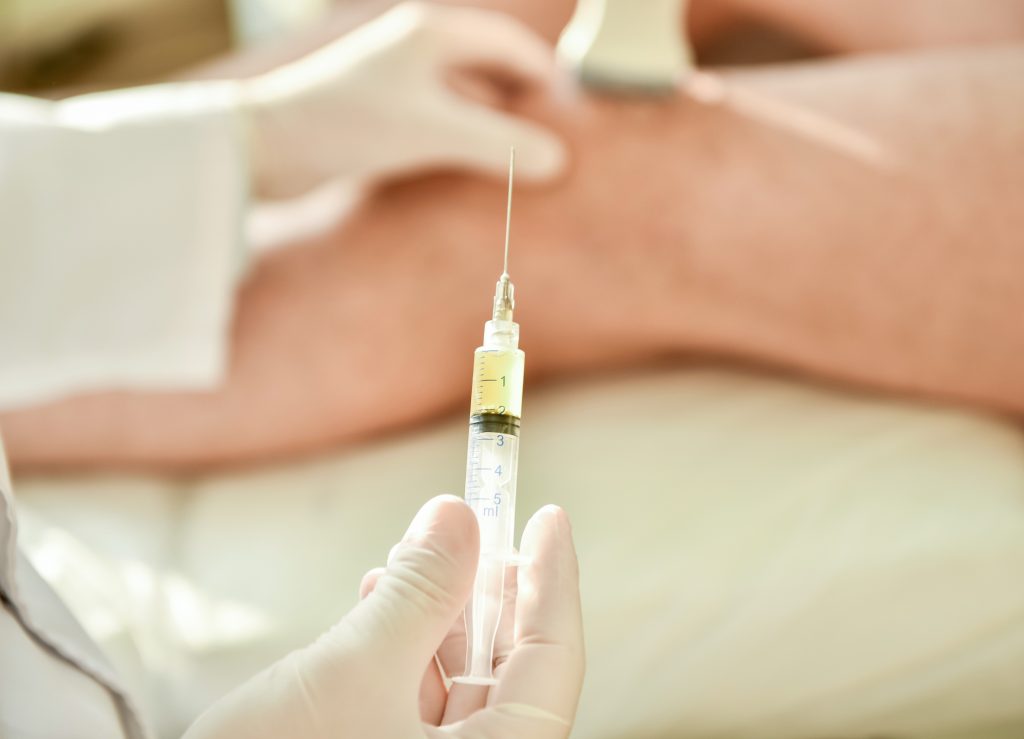
Platelet-rich plasma (PRP) therapy is a cutting-edge technology that treats everything from hair loss and aging skin to infertility and wound healing. It’s not just a passing trend. It’s a promising treatment for musculoskeletal conditions that promotes healing and reduces pain without invasive surgeries or heavy medications. PRP therapy harnesses your body’s own healing abilities to regenerate soft tissue, reduce inflammation, and ease pain.[1]
What Is Platelet-Rich Plasma?
Platelet-rich plasma (PRP) is a concentrated substance derived from your own blood. Plasma is the liquid part of your blood, and platelets are blood cells that respond when healing is needed.[2] Platelets are the “first responders” when an injury or damage occurs. They release proteins and growth factors that stimulate healing and new cell growth.[2]
Before treatment, your blood is drawn, and the sample is spun in a centrifuge. This process separates and concentrates the platelets to ensure a higher-than-normal level of growth factors and proteins.[3] The collected PRP is injected into the injury site or painful area to supercharge your body’s healing abilities. Relief is not immediate, as natural healing takes a few weeks to deliver noticeable results and a few months to experience the full benefits of PRP.
How PRP Reduces Pain Naturally
PRP is an orthobiologic derived from your blood that helps accelerate the body’s natural healing process and tissue repair.[4] It works by concentrating platelets rich in growth factors and injecting them into injured or inflamed areas to reduce pain and promote recovery. Although PRP was initially used in the 1970s for its clotting properties, its regenerative benefits have made it increasingly popular in orthopedic and sports medicine settings.[4] Over the past decade, its application in managing musculoskeletal pain and injuries has grown significantly due to its minimally invasive, drug-free approach to healing.[4]
Here’s how platelet-rich plasma (PRP) reduces pain:
- Stimulates healing: PRP growth factors jumpstart the repair process by encouraging the production of new cells and tissue. [4] The growth factors in PRP jump-start the repair process by encouraging the production of new cells and tissues.[4] It can speed healing, shorten injury recovery times, and reduce pain.[2] PRP therapy treats musculoskeletal pain and injuries like ligament tears, tendonitis, surgical wounds, and arthritis.[2]
- Reduces inflammation: Chronic pain often stems from ongoing inflammation. PRP’s anti-inflammatory and analgesic properties reverse long-term inflammation, calming the affected tissue and relieving pain.[1]
- Improves function: By addressing the root cause of pain, such as damaged tissues or slow-healing injuries, PRP can restore mobility and improve function over time.[2] PRP therapy helps improve the movement of arthritic joints by reducing inflammation and stiffness.[3]
What Can PRP Therapy Treat?
PRP therapy is widely used in both orthopedic and sports medicine to help manage pain and support healing in a range of musculoskeletal conditions. It offers a non-surgical option for patients dealing with chronic discomfort or injuries affecting mobility and function. The treatment has shown positive results in various clinical applications, including the following:
- Torn tendons [5]
- Tendinitis [5]
- Muscle injuries [5]
- Joint injuries [5]
- Arthritis [5]
- Tennis elbow [5]
- Low back pain [1]
- Knee pain [1]
- Myofascial pain syndrome [1]
- Frozen shoulder [6]
- Rotator cuff tear [6]
- Facet joints [6]
- Bursitis [6]
- Carpal Tunnel [6]
- Neck pain [7]
- Cartilage, ligament and tendon injuries [7]
- Degenerative spine disease [8]
Surgery and Medication Alternatives
One of the most appealing features of PRP therapy is its ability to offer patients an alternative to surgery and medications such as opioids.
- Non-invasive: Unlike surgery, PRP involves no incisions, stitches, or significant downtime.[8] The injection is an outpatient procedure that allows you to return to your daily routine quickly.
- Reduces medication use: Many patients seek PRP therapy to avoid long-term dependence on painkillers, including opioids.[4] By targeting the root cause of pain, PRP can provide relief with no medication or conservative medication use, reducing the risk of addiction or side effects.
- Natural healing: Because PRP uses your own blood, there’s minimal risk of rejection or allergic reactions, making it a safer alternative to synthetic treatments.[9]
Is PRP Therapy the Answer to Your Musculoskeletal Pain?
If you’ve been experiencing chronic pain due to any number of muscle, joint or soft tissue injuries, PRP injections can help without surgery or long-term medication use. This natural and effective treatment can reduce pain, promote healing, shorten recovery, and improve mobility. PRP therapy is also ideal if you’re seeking a convenient treatment as it takes about an hour, and the effects last anywhere from several months to a year or more.
PRP therapy is the answer you’ve been seeking to promote pain relief at the root of the problem. Whether you’re dealing with joint pain, a sports injury, or a chronic condition, this innovative treatment will harness your body’s healing ability. Talk with a reputable pain specialist to learn more about PRP therapy and determine if regenerative medicine is right for you!
Resources:
- Thu AC. The use of platelet-rich plasma in management of musculoskeletal pain: a narrative review. J Yeungnam Med Sci [Internet]. 2022;39(3):206-215. doi:10.12701/jyms.2022.00290. Accessed January 17, 2025. Available from: https://pmc.ncbi.nlm.nih.gov/articles/PMC9273137/
- Platelet-Rich Plasma (PRP) Treatment. Johns Hopkins Medicine [Internet]. Published 2024. Accessed January 17, 2025. Available from: https://www.hopkinsmedicine.org/health/treatment-tests-and-therapies/plateletrich-plasma-prp-treatment
- Nall R. What you need to know about platelet-rich plasma (PRP) therapy. Medical News Today [Internet]. Accessed January 17, 2025. Available from: https://www.medicalnewstoday.com/articles/320107
- Dhillon RS, Schwarz EM, Maloney MD. Platelet-rich plasma therapy – future or trend?. Arthritis Res Ther [Internet]. 2012;14(4):219. Published 2012 Aug 8. doi:10.1186/ar3914. Accessed January 17, 2025. Available from: https://pmc.ncbi.nlm.nih.gov/articles/PMC3580559/
- Pagán CN, Seed S. Platelet-Rich Plasma Injections: What to Know. WebMD [Internet]. Reviewed December 14, 2023. Accessed January 17, 2025. Available from: https://www.webmd.com/fitness-exercise/platelet-rich-plasma-injections
- Pretorius J, Habash M, Ghobrial B, Alnajjar R, Ellanti P. Current Status and Advancements in Platelet-Rich Plasma Therapy. Cureus [Internet]. 2023;15(10):e47176. Published 2023 Oct 17. doi:10.7759/cureus.47176. Accessed January 17, 2025. Available from: https://pmc.ncbi.nlm.nih.gov/articles/PMC10652151/
- Platelet-Rich Plasma (PRP) Injections in Sports. Yale Medicine [Internet]. Accessed January 17, 2025. Available from: https://www.yalemedicine.org/conditions/platelet-rich-plasma-injections
- Apostolakis S, Kapetanakis S. Platelet-Rich Plasma for Degenerative Spine Disease: A Brief Overview. Spine Surg Relat Res [Internet]. 2023;8(1):10-21. Published 2023 Jul 6. doi:10.22603/ssrr.2023-0079. Accessed January 17, 2025. Available from: https://pmc.ncbi.nlm.nih.gov/articles/PMC10853612
- Jain NK, Gulati M. Platelet-rich plasma: a healing virtuoso. Blood Res [Internet]. 2016;51(1):3-5. doi:10.5045/br.2016.51.1.3. Accessed January 17, 2025. Available from: https://pmc.ncbi.nlm.nih.gov/articles/PMC4828525/