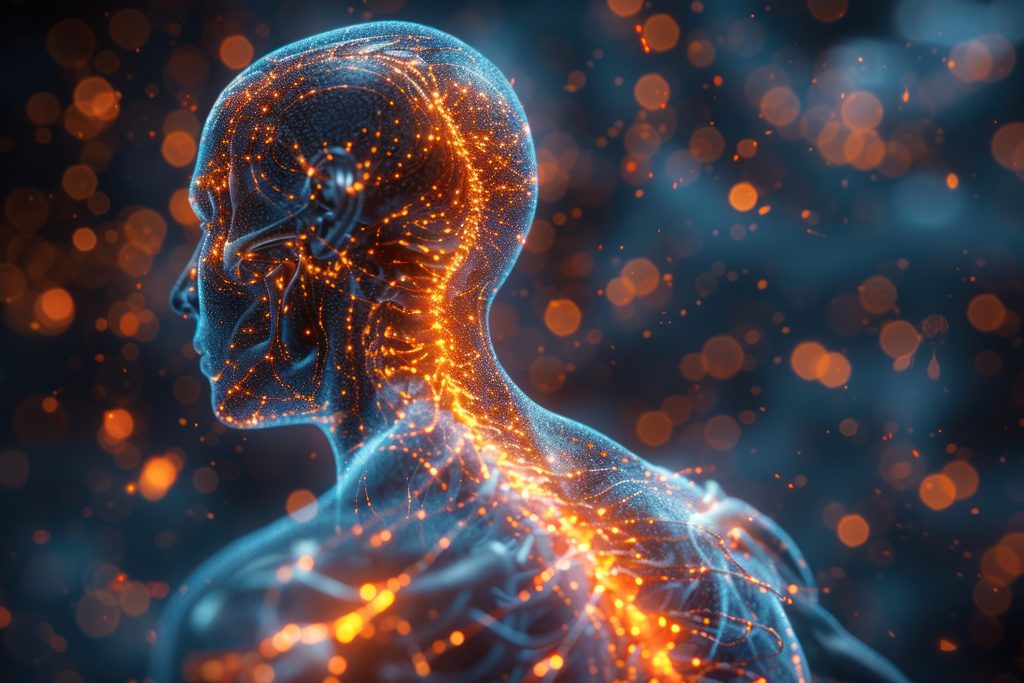
Chronic pain isn’t just pain that sticks around longer than expected—it’s pain that actually changes how your nervous system works. When pain lingers for months or years, your brain, spinal cord, and nerves don’t keep sending the same signals.[1] They adapt, rewire, and sometimes become overly sensitive, so even harmless sensations can trigger intense pain.[2]
Over time, the nervous system can start to misinterpret signals. Pain messages fire when they shouldn’t, normal sensations feel threatening, and the brain stays stuck in “danger mode.”[3] This is how chronic pain can gradually reshape the central nervous system itself.
What Happens to Your Nervous System When Pain Doesn’t Stop?
When your nervous system is healthy, pain is an alarm. The warning signal alerts your brain to injury or danger, but quiets down once the injury is healed. Chronic pain overrides the “off switch,” allowing pain signals to keep firing even when there is no active injury or danger.[3]
When the barrage of pain signaling continues over long periods, it can cause structural and functional changes in your brain, especially in areas involved in sensation, emotion, and decision-making.[4; 5] Your spinal cord also becomes more reactive and amplifies pain messages before they even reach your brain.[6]
How the Nervous System Becomes Overprotective Rather Protective
As chronic pain persists, the nervous system doesn’t just keep reacting—it starts anticipating pain. This heightened state of vigilance is meant to protect you, but over time, it can backfire, causing the system to respond too aggressively to normal input.
One key mechanism behind this shift is central sensitization, which helps explain why pain can intensify and spread even without new injury.
Central Sensitization and Nociplastic Pain
Chronic pain isn’t always caused by ongoing tissue damage (nociceptive pain) or direct nerve injury (neuropathic pain). Central sensitization, also called nociplastic pain, is a newer and increasingly recognized pain mechanism.
[7]
Central sensitization occurs when the central nervous system becomes overly responsive to sensory input, meaning normal sensations or mild stimuli feel painful.[8]
With central sensitization, you may experience:
- Amplified pain signals even without ongoing tissue damage. [9]
- Your brain may interpret harmless touch, movement, or temperature as intense pain. [10]
- Your pain is felt beyond the original injury site. [11]
Nociplastic pain caused by central sensitization helps explain why imaging tests may appear “normal” even when pain feels very real and intense. It plays a role in chronic conditions and central pain syndromes like IBS, fibromyalgia, chronic fatigue syndrome, pelvic pain, facial pain, headaches and neck or back pain.[7]
Neuropathic Pain as a Nervous System Disorder
If your chronic pain involves damaged or malfunctioning nerves, you may be experiencing neuropathic pain. Instead of your peripheral nerves responding appropriately to injury, they may send pain signals on their own or exaggerate normal sensory input.[10]
Nerve pain often feels different from other types of pain and is commonly described as burning, shooting, electric, tingling, or stabbing.[12] An abnormal nervous system causes your neuropathy, so symptoms may persist after tissues heal, and your pain may not respond to conventional treatments.[6]
Complex Regional Pain Syndrome (CRPS) and Nervous System Dysregulation
A more severe example of nervous system–driven pain is complex regional pain syndrome (CRPS). CRPS-1 typically develops after an injury or surgery, but the pain becomes far more intense and long-lasting than expected.[13]
CRPS-1 is characterized by widespread dysregulation of the nervous system, with abnormal pain signaling, sensory processing, and autonomic function.[14]
In addition to severe pain, CRPS may involve:
- Changes in skin color, temperature, or swelling [13]
- Heightened sensitivity to touch or movement [14]
- Persistent pain that is disproportionate to the original injury [15]
CRPS illustrates how chronic pain can drive long-term changes across the nervous system rather than remaining confined to a single injured area.[6]
Why Chronic Pain Tends to Persist and Spread Over Time
As chronic pain continues unchecked, your nervous system doesn’t just stay sensitive; it can get stuck in protection mode. The brain and spinal cord begin to react as if danger were always present, even when tissues are no longer being harmed.[3]
Chronic pain can also keep the body’s fight-or-flight response switched on, further amplifying pain signals and making rest and recovery harder.[3]
This ongoing state of alert can involve the body’s stress response, keeping pain pathways active and making the system more reactive to everyday sensations. Over time, pain may feel more widespread, harder to predict, and less connected to a specific injury.[6]
These changes help explain why chronic pain often becomes more complex the longer it goes untreated and why addressing the nervous system directly is such an essential part of effective care.
A Different Way to Think About How Chronic Pain Affects Your Nervous System
Chronic pain doesn’t mean your body is failing you (even though it feels like it). It just means your nervous system has learned a pattern that once made sense but no longer serves you. When pain is viewed through this lens, treatment shifts from simply “chasing symptoms” to calming, retraining, and supporting the nervous system as a whole.
The encouraging reality is that the nervous system is adaptable. Just as it can learn pain, it can also learn safety, movement, and balance again (this is known as neuroplasticity).[16] With the right combination of treatments delivered through a comprehensive interventional pain management approach, your pain intensity decreases, function improves, and confidence in your body returns.
Understanding how chronic pain changes the nervous system helps replace frustration with clarity—and opens the door to a more effective, individualized pain care plan focused on long-term relief and improving your quality of life.
Disclaimer: This content is for educational purposes only and is not a substitute for medical advice, diagnosis, or treatment. Pain conditions and treatment options vary from person to person, so always talk with a qualified healthcare provider about what’s right for you. If you experience sudden or worsening pain, or symptoms like numbness, weakness, chest pain, shortness of breath, or changes in bladder or bowel control, seek medical care right away.
Resources:
- Cleveland Clinic. Chronic pain. Cleveland Clinic. Published 2021. Accessed January 28, 2026. Available from: https://my.clevelandclinic.org/health/diseases/4798-chronic-pain
- What is chronic pain? NHS Inform [Internet]. Published October 20, 2023. Accessed January 28, 2026. Available from: https://www.nhsinform.scot/illnesses-and-conditions/brain-nerves-and-spinal-cord/chronic-pain/what-is-chronic-pain/
- Yang S, Chang MC. Chronic Pain: Structural and Functional Changes in Brain Structures and Associated Negative Affective States. Int J Mol Sci [Internet]. 2019 Jun 26;20(13):3130. doi: 10.3390/ijms20133130. PMID: 31248061; PMCID: PMC6650904. Accessed January 28, 2026. Available from: https://pmc.ncbi.nlm.nih.gov/articles/PMC6650904/#cen
- New discovery: how chronic pain changes your brain and personality. NeuRA [Internet]. Accessed January 28, 2026. Available from: https://neura.edu.au/news-media/media-releases/new-discovery-how-chronic-pain-changes-your-brain-and-personality
- De Ridder D, Adhia D, Vanneste S. Accessed January 28, 2026. Available from: The anatomy of pain and suffering in the brain and its clinical implications. Neuroscience & Behavioral Reviews [Internet]. 2021; 130:125-126. https://doi.org/10.1016/j.neubiorev.2021.08.013 Accessed January 28, 2026. Available from: https://www.sciencedirect.com/science/article/pii/S0149763421003560
- Garland EL. Pain processing in the human nervous system: a selective review of nociceptive and biobehavioral pathways. Prim Care [Internet]. 2012 Sep;39(3):561-71. doi: 10.1016/j.pop.2012.06.013. Epub 2012 Jul 24. PMID: 22958566; PMCID: PMC3438523. Accessed January 28, 2026. Available from: https://pmc.ncbi.nlm.nih.gov/articles/PMC3438523/
- Mohabbat AB, Wilkinson JM. Central Sensitization: When It Is Not “All in Your Head.” American Family Physician [Internet]. 2023;107(1):92-96. Accessed January 28, 2026. Available from: https://www.aafp.org/pubs/afp/issues/2023/0100/curbside-central-sensitization.html
- Yoo YM, Kim KH. Current understanding of nociplastic pain. Korean J Pain [Internet]. 2024 Apr 1;37(2):107-118. doi: 10.3344/kjp.23326. Epub 2024 Mar 20. PMID: 38504389; PMCID: PMC10985487. Accessed January 28, 2026. Available from: https://pmc.ncbi.nlm.nih.gov/articles/PMC10985487/
- Dydyk AM, Chiebuka E, Stretanski MF, et al. Central Pain Syndrome. [Updated 2025 May 3]. In: StatPearls [Internet]. Treasure Island (FL): StatPearls Publishing; 2025 Jan-. Accessed January 28, 2026. Available from: https://www.ncbi.nlm.nih.gov/books/NBK553027/
- Barad M, Aggarwal A. Chronic Widespread Pain. Merck Manual Consumer Version [Internet]. Revised April 2025. Accessed January 28, 2026. Available from: https://www.merckmanuals.com/home/brain-spinal-cord-and-nerve-disorders/pain/chronic-widespread-pain
- Jaffal SM. Neuroplasticity in chronic pain: insights into diagnosis and treatment. The Korean journal of pain [Internet]. 2025;38(2):89-102. doi:https://doi.org/10.3344/kjp.24393 Accessed January 28, 2026. Available from: https://www.epain.org/journal/view.html?doi=10.3344/kjp.24393
- National Library of Medicine. “Ouch, that hurts!” The Science of Pain. NIH MedlinePlus Magazine. Published May 23, 2023. Accessed January 28, 2026. Available from: https://magazine.medlineplus.gov/article/ouch-that-hurts-the-science-of-pain
- Cleveland Clinic. Complex regional pain syndrome (CRPS): Symptoms & treatments. Cleveland Clinic [Internet]. Published September 30, 2022. Accessed January 28, 2026. Available from: https://my.clevelandclinic.org/health/diseases/12085-complex-regional-pain-syndrome-crps
- De Schoenmacker I, Mollo A, Scheuren PS, Sirucek L, Brunner F, Schweinhardt P, Curt A, Rosner J, Hubli M. Central sensitization in CRPS patients with widespread pain: a cross-sectional study. Pain Med [Internet]. 2023 Aug 1;24(8):974-984. doi: 10.1093/pm/pnad040. PMID: 36946277; PMCID: PMC10391588. Accessed January 28, 2026. Available from: https://pmc.ncbi.nlm.nih.gov/articles/PMC10391588/
- Costigan M, Scholz J, Woolf CJ. Neuropathic pain: a maladaptive response of the nervous system to damage. Annu Rev Neurosci. 2009;32:1-32. doi: 10.1146/annurev.neuro.051508.135531. PMID: 19400724; PMCID: PMC2768555. Accessed January 28, 2026. Available from: https://pmc.ncbi.nlm.nih.gov/articles/PMC2768555/#
- Puderbaugh M, Emmady PD. Neuroplasticity. [Updated 2023 May 1]. In: StatPearls [Internet]. Treasure Island (FL): StatPearls Publishing; 2025 Jan-. Accessed January 28, 2026. Available from: https://www.ncbi.nlm.nih.gov/books/NBK557811/